
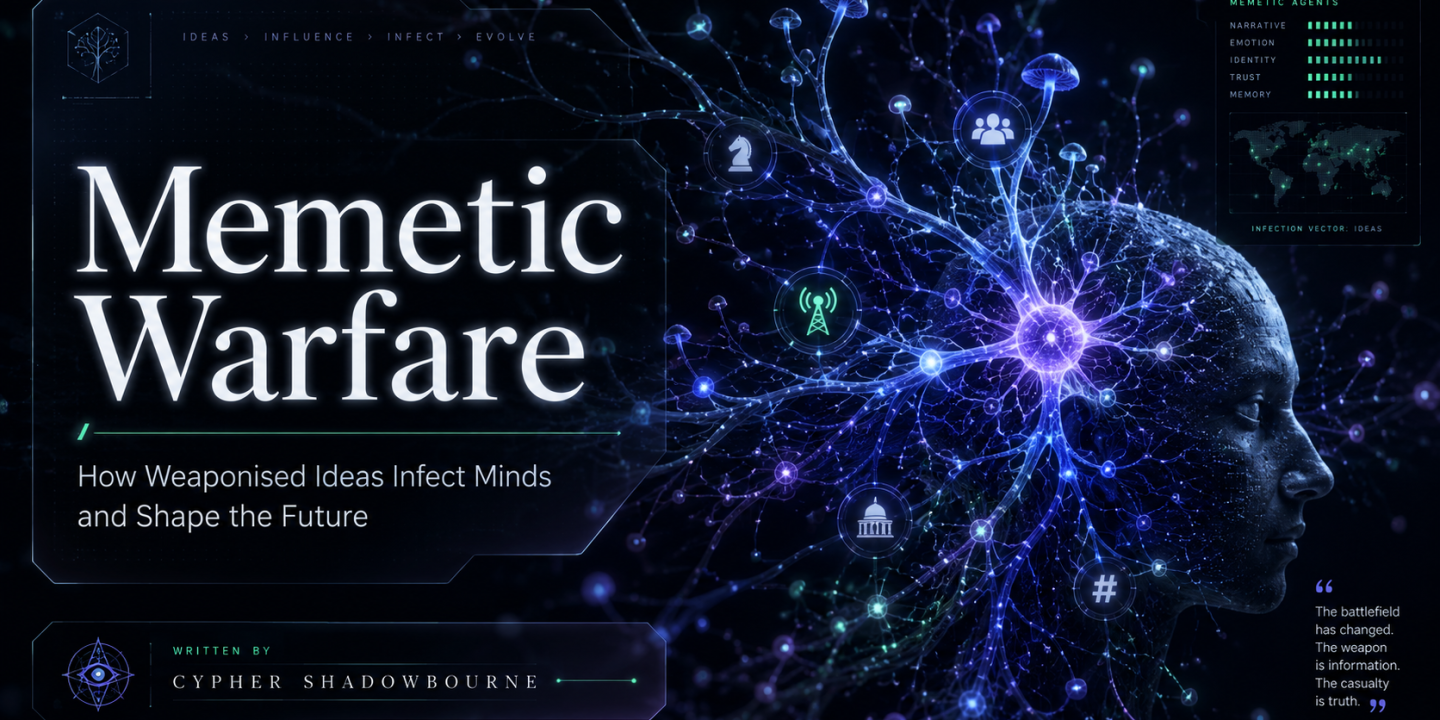
Memetic Warfare: How Weaponised Ideas Infect Minds and Shape the Future
Think of words as memetic lifeforms — mind viruses, if you like.
Once spoken, written, shared, posted, repeated, mocked, remixed, or weaponised, they take on a life of their own. They escape the bounds of the speaker’s mind and begin moving through the wider ecology of human consciousness.
They grow organically.
They evolve.
They mutate.
They pass from person to person, from group to group, from platform to platform, dispersing throughout the zeitgeist like a mycelial web beneath the visible surface of culture.
Some ideas remain dormant for years.
Some wait for crisis.
Some infiltrate quietly.
Some erupt violently.
Some become part of the ideological DNA of entire societies.
And some, once embedded deeply enough, become almost impossible to remove.
This is the terrain of memetic warfare.
The Mycelial Model
Like a mycelial web, some ideas spread silently and undetected, enmeshing themselves into the fabric of cultural consciousness.
They do not always require a dramatic crisis to emerge. They require fertile ground, sustained repetition, emotional nourishment, and the subtle assistance of confirmation bias.
They expand beneath the surface.
They appear dormant.
Then, when the conditions are right, they fruit.
What was once invisible becomes visible as movements, slogans, identities, ideologies, rituals, political alignments, and cultural instincts.
A mycelial idea does not need to dominate immediately. Its strength lies in persistence. It waits beneath the visible battlefield, quietly connecting nodes, feeding itself through repetition, and preparing for re-emergence.
Examples
Democracy, feminism, human rights, and environmentalism all developed across long historical timescales. They did not appear fully formed. They matured, receded, adapted, and returned.
Liberalism, too, can be understood as a post-Enlightenment construct that spread slowly through institutions, legal systems, education, commerce, and culture. Today, it manifests globally, even as it comes under siege from authoritarian, reactionary, and illiberal forces.
Tactical Advantage
The mycelial model is resilient.
You can destroy the visible fruiting bodies — the protest, the slogan, the organisation, the publication, the public figure — but the web beneath may remain intact.
Mycelial memes also share resources across disparate ideological ecosystems. Their origin can become obscured. Their intent can become difficult to trace. They may infiltrate different communities under different names, symbols, or emotional framings.
Tactical Disadvantage
Mycelial networks can be disrupted by altering the ideological soil.
Expose the underlying connections. Reveal the hidden architecture. Make the covert pathways visible. Once the pattern is illuminated, the spell weakens.
Their other weakness is speed. Slow propagation can be outpaced by faster, more aggressive ideologies, especially during crises.
The Tick Model
Some ideologies do not spread constantly.
They lie dormant.
They wait.
Like ticks, they remain inactive until activated by environmental cues. A tick senses heat, breath, proximity, and opportunity. Dormant ideologies sense instability, humiliation, economic collapse, cultural fear, geopolitical turmoil, institutional distrust, and war.
Then they awaken.
The tick model explains why certain ideas seem to vanish from public life, only to return with shocking speed when conditions become favourable.
They were never dead.
They were waiting.
Examples
Fascism, extreme nationalism, reactionary politics, and anti-Semitic conspiracy theories often follow this pattern. They may retreat from respectable discourse, but they remain encoded in cultural memory, fringe networks, coded language, private grievance, and mythic resentment.
When crisis arrives, they activate.
The language changes.
The clothing changes.
The platform changes.
The underlying infection remains recognisable.
Tactical Advantage
The tick model has explosive activation.
Once the proper conditions emerge, these memes can spread rapidly, infecting communities with hate, suspicion, derision, and scapegoating.
They thrive in crisis because crisis weakens complexity. People seek simple explanations, visible enemies, and emotionally satisfying narratives. Tick memes provide all three.
Tactical Disadvantage
Their weakness is dependence.
Without suitable crisis conditions, they remain dormant or marginal. Their activation pattern also makes them somewhat predictable. When societies understand the environmental cues that activate these memes, they can prepare countermeasures before the outbreak spreads.
The Symbiotic Model
Some memetic lifeforms do not merely spread through a host.
They take over the host.
They subvert agency and become the dominant identity. The person does not simply believe the idea. The idea becomes the organising principle through which they interpret reality, community, morality, loyalty, betrayal, and selfhood.
Outwardly, the host may appear normal.
Internally, the meme has occupied the command structure.
This is the symbiotic model.
The person no longer carries the ideology.
The ideology carries them.
Examples
Extremist cults, QAnon, religious extremism, ideological puritanism, and totalising political identities can all operate through this model.
The host does not merely agree.
They recruit.
They defend.
They rationalise.
They evangelise.
They interpret all contrary evidence as proof of persecution, conspiracy, or corruption.
Tactical Advantage
Symbiotic memes are self-replicating.
Hosts actively work to spread the infection because they perceive propagation as loyalty, virtue, awakening, duty, or salvation.
These memes are also resistant to removal because they become fused with identity. To challenge the meme feels, to the host, like an attack on the self.
Tactical Disadvantage
Their rigidity is also their weakness.
Because the meme dominates identity so completely, it may struggle to adapt when confronted with incontrovertible reality. Symbiotic memes can also become isolated when recognised as dangerous, leading to containment, fragmentation, or internal collapse.
The Viral Mutation Model
Viruses adapt.
They mutate.
They alter their surface expression to evade immune detection while preserving the core payload.
Memetic viruses do the same.
A hostile idea may change its language, symbols, aesthetic, emotional tone, or political costume while retaining the same underlying structure.
This is memetic antigenic drift.
The meme does not abandon its purpose.
It changes its mask.
Examples
Anti-immigrant rhetoric may shift from overt xenophobia to language about economic pressure, cultural preservation, border anxiety, or national security.
Anti-vaccine movements may mutate from claims about health risks into narratives about freedom, bodily autonomy, state control, or distrust of institutions.
Radical ideologies may launder themselves through softer language, ironic humour, coded references, or apparently reasonable concerns.
The payload remains.
The packaging evolves.
Tactical Advantage
The viral mutation model is highly adaptive.
It exploits cognitive blind spots. It evades fact-checking. It outruns moderation systems. It changes shape faster than institutions can respond.
By the time one expression is challenged, the meme has already migrated into another form.
Tactical Disadvantage
Constant mutation can weaken cohesion.
If the meme changes too often, its followers may fragment. The original base may feel alienated. The mutation may preserve survivability while sacrificing clarity, discipline, or ideological unity.
Memetic Countermeasures
In a world where words are weapons and ideas evolve like viruses, passivity is a slow death.
Neutrality is not always neutral.
If you are not actively defending your cognitive environment, someone else may already be shaping it for you.
Countermeasures must be proactive, precise, ethical, and adaptive. The objective is not to replace one manipulation with another, but to preserve cognitive sovereignty: the ability to think, interpret, question, and resist hostile narrative capture.
1. Frame and Reframe: Linguistic Jujitsu for the Mind
The first rule of memetic warfare is this:
Control the frame, or be framed by it.
Words are not merely carriers of meaning. They are tactical payloads.
Reframing is linguistic jujitsu. It uses the momentum of a hostile meme against itself by shifting the narrative context so that the original message becomes unstable, exposed, or self-defeating.
For example, if a divisive meme frames immigration purely as an economic threat, a reframing countermeasure may shift attention towards labour contribution, demographic necessity, cultural enrichment, or the economic systems that exploit migrant and native workers alike.
This is not spin.
It is the strategic rewriting of memetic DNA.
2. Narrative Inoculation: Cognitive Vaccination Against Ideological Viruses
Prevention is more effective than cure.
Narrative inoculation works by exposing people to weakened forms of harmful ideas before they encounter the full-strength version. Like a vaccine, it prepares the cognitive immune system.
The key is subtlety.
If the counter-narrative is too overt, it may trigger psychological reactance. People may double down, not because the original idea is strong, but because they feel their autonomy has been threatened.
A better method is to introduce doubt before certainty hardens.
Seed complexity.
Expose manipulation techniques.
Encourage pattern recognition.
Make simplistic explanations less seductive before they become identity.
3. Semantic Sabotage: Disrupting Enemy Supply Lines
Language is logistics.
Just as cutting off supply lines can cripple an army, disrupting the language supply lines of hostile memes can weaken their spread.
This involves identifying key terms, slogans, insults, euphemisms, and symbolic phrases — the memetic munitions — that carry hostile payloads.
Some can be neutralised through exposure.
Some can be diluted through parody.
Some can be reframed.
Some can be deprived of emotional charge.
The goal is not censorship. The goal is disarmament.
A toxic phrase loses power when its mechanism becomes visible.
4. Cognitive Firewalls: Building Ideological Red Teams
You cannot defend what you do not understand.
Cognitive firewalls are mental defence systems built through critical thinking, scepticism, adversarial analysis, and exposure to competing viewpoints.
This is ideological red teaming.
Train people to recognise:
- false dilemmas
- appeal to fear
- scapegoating
- emotional manipulation
- conspiracy framing
- slippery slopes
- purity tests
- loaded language
- identity traps
- algorithmic rage-bait
The mind must learn to detect hostile code before it executes.
5. Feedback Loop Disruption: Cutting the Hydra’s Heads
Memetic warfare thrives on feedback loops.
Every share, repost, quote-tweet, reaction, argument, and outrage comment can become oxygen for the hostile meme.
Sometimes the best response is not amplification.
Sometimes the most disciplined act is refusal.
Feedback loop disruption requires two forms of countermeasure:
First, algorithmic countermeasures that reduce the reward structure for toxic virality.
Second, social countermeasures that train people to pause before engaging with inflammatory material.
This is memetic hygiene:
Verify before sharing.
Pause before reacting.
Recognise emotional hooks.
Avoid feeding rage cycles.
Respond with precision, not panic.
6. Memetic Honey Traps: Luring and Neutralising Ideological Threats
A memetic honey trap is a deliberately crafted narrative that attracts a hostile meme and exposes its contradictions.
The hostile meme is allowed to overextend itself.
Its absurdity becomes visible.
Its internal contradiction becomes the trap.
Its own virality becomes the mechanism of exposure.
This technique is dangerous if used carelessly. It requires ethical discipline. The aim should be illumination, not deception for its own sake.
The line between countermeasure and manipulation must remain visible.
7. Ideological Guerrilla Warfare: Small-Scale but Strategic Strikes
Not every countermeasure needs to be grand.
Sometimes a small, precise intervention can destabilise a large hostile narrative.
Micro-memes can act as strategic strikes against core assumptions. A sentence, image, question, juxtaposition, or symbolic inversion can force second-order thinking.
The objective is not to overpower the hostile ideology directly.
It is to make the host think twice.
A well-placed question can do more damage to a brittle ideology than a thousand shouted corrections.
Ethical Considerations
The line between narrative reframing and manipulation cannot be ignored.
Memetic warfare presents a paradox: to counter manipulation, one must understand the tools of influence. But understanding the tools does not grant moral permission to use them without restraint.
The ethical question is not merely:
“Does this work?”
The deeper question is:
“Does this preserve cognitive sovereignty, or does it merely replace one form of capture with another?”
Influence must be examined.
Counter-influence must be examined too.
Otherwise, the cure becomes another infection.
Feedback Loops and Cognitive Science
Memetic warfare creates feedback loops.
Offensive and defensive memes evolve in response to one another. Each correction, denial, satire, exposure, or counter-narrative may alter the behaviour of the original meme.
Cognitive science matters here.
Confirmation bias, schema theory, emotional salience, identity-protective cognition, and echo chambers all shape how memes survive.
A hostile meme does not spread only because people are ignorant.
It spreads because it attaches itself to existing cognitive structures.
It feeds on wounds, fears, loyalties, grievances, and unfinished meanings.
To counter it, one must understand not only the message, but the mind that receives it.
The Resistance Needs You
Resistance is not futile.
But you cannot fight an enemy you do not recognise.
Learn to identify the memetic forms moving through the cultural battlefield.
Which ideas are mycelial — quiet, covert, slowly spreading beneath the surface?
Which are ticks — dormant but dangerous, waiting for crisis?
Which are symbiotic — taking over the host and becoming identity?
Which are viral mutations — changing their surface expression to bypass resistance?
Recognition is the first act of resistance.
Interpretation is the battlefield.
Meaning is the terrain.
Who Will Control the Memetic Battlefield of the Future?
The ultimate battle is not fought with kinetic weapons alone.
It is fought with words, narratives, images, symbols, myths, emotions, and memes.
It is fought through the stories people tell about themselves.
It is fought through the enemies they are taught to fear.
It is fought through the futures they are allowed to imagine.
The memetic battlefield of the future is already here.
The question is not whether we enter it.
We are already inside it.
The question is whether we remain unconscious hosts — or become sovereign participants in the struggle over meaning.
Glossary of Terms
Memetic Warfare
The strategic use of memes, ideas, and information patterns to influence, manipulate, or control the beliefs and actions of groups or societies.
Memetic Lifeforms
A way of describing memes as if they are living entities capable of growing, spreading, mutating, adapting, and surviving in different cultural environments.
Mycelial Web
A network of fungal threads that spread underground, unseen, before producing visible fruiting bodies. In memetics, this represents how some ideas spread covertly until conditions allow them to emerge visibly.
Fruiting Bodies
The visible expression of an underlying network. In this context, fruiting bodies are the public actions, slogans, movements, or symbols produced by deeper ideological structures.
Fertile Ground
A receptive audience or cultural environment where certain ideas can easily take root and grow.
Ideological DNA
The core beliefs, values, assumptions, and symbolic codes that form the foundation of an ideology.
Tactical Advantage
The strengths that allow a particular memetic strategy to spread, survive, and influence behaviour.
Tactical Disadvantage
The weaknesses or vulnerabilities that can be exploited to counter or neutralise a memetic strategy.
Memetic Mutation
The process by which a meme changes its appearance, language, or framing while preserving its core payload.
Core Payload
The central idea or message that a meme carries, even when its outward expression changes.
Memetic Recombination
The process by which two or more memes combine to form a new hybrid idea that may spread more effectively.
Dormant
Inactive but capable of becoming active when conditions are favourable.
Explosive Activation
The rapid spread of a meme or ideology once the correct conditions, such as crisis or instability, are present.
Crisis Opportunism
The ability of certain memes or ideologies to thrive during periods of fear, uncertainty, collapse, or conflict.
Symbiotic
A relationship in which a meme becomes deeply fused with the host’s beliefs, identity, and behaviour.
Self-Replication
The ability of a meme to spread itself by convincing hosts to propagate it willingly.
Cognitive Blind Spots
Unexamined gaps in perception or reasoning that make people vulnerable to manipulation.
Fragmentation
The breaking apart of a group, movement, or ideology into smaller and less cohesive factions.
Semantic Shifts
Changes in the meaning or interpretation of words and phrases over time.
Resistance to Removal
The difficulty of removing a belief once it has become deeply embedded in identity and neural structure.
Inoculation
A strategy of exposing people to weakened forms of harmful ideas to build resistance against stronger versions.
Fact-Checking
The process of verifying whether information is accurate, reliable, and grounded in evidence.
Deprogramming
The careful process of helping someone break free from deeply ingrained beliefs by introducing alternative viewpoints without triggering defensive collapse.
Memetic Countermeasures
Strategies designed to resist, neutralise, expose, or redirect harmful memes.
Narrative
A story or explanatory structure through which people make sense of events, identity, history, and power.
Cognitive Wall
A mental defence system built through critical thinking, scepticism, pattern recognition, and ideological self-awareness.
Eternal Vigilance
The principle that constant awareness is necessary to defend against memetic threats.
Antigenic Drift
In biology, antigenic drift describes subtle viral mutations that allow viruses to evade immune detection. In memetic warfare, it describes the gradual modification of language, framing, or surface expression while retaining the core message.
Enmesh
To become deeply entangled within a system. In memetics, enmeshment describes how ideas become embedded in cultural consciousness or belief systems, making them difficult to dislodge.
Leave a Reply